
A clinical overview of ADHD features and treatment
What is ADHD?
ADHD (Attention Deficit Hyperactivity Disorder) is a neurodevelopmental disorder with global symptoms concerning attention deficits, hyperactivity and impulsivity, from which the name of ADHD stems. It can be detected both in children and adults, since it undoubtedly begins in childhood and continues to adulthood in at least 2/3 of cases (Adult ADHD).
Adult ADHD
Adult ADHD is ADHD that manifests itself in the adult population as a continuation from childhood and adolescence. In recent years, there has been increased awareness in the global psychiatric community about the recognition of the disorder. It has also been included as an official diagnosis in the latest classification manual of psychiatric disorders of the American Psychiatric Association (DSM-V).
Despite the aforementioned awareness, ADHD in adults is perhaps one of the least recognized disorders worldwide, while its prevalence reaches up to 5% in the general population, which is particularly high when one considers, for example, that the various types of anxiety disorders separately have similar rates of occurrence. ADHD shows a clear preference for the male sex in a ratio of at least 3:1.
Children’s ADHD
ADHD in childhood and teenage years, can cause various problems in school and social functioning among children, due to difficulty concentrating, and often co-occurs with other entities such as anxiety disorders, mood, behavior (behavioral disorder, coping disorder) and substance use. In over 60% of cases the disorder persists even with a partial remission in adulthood. Risk factors for the onset of the disorder include family history, symptom severity, combined type (see below), comorbidity, and aggravating environmental factors.
ADHD-Symptoms
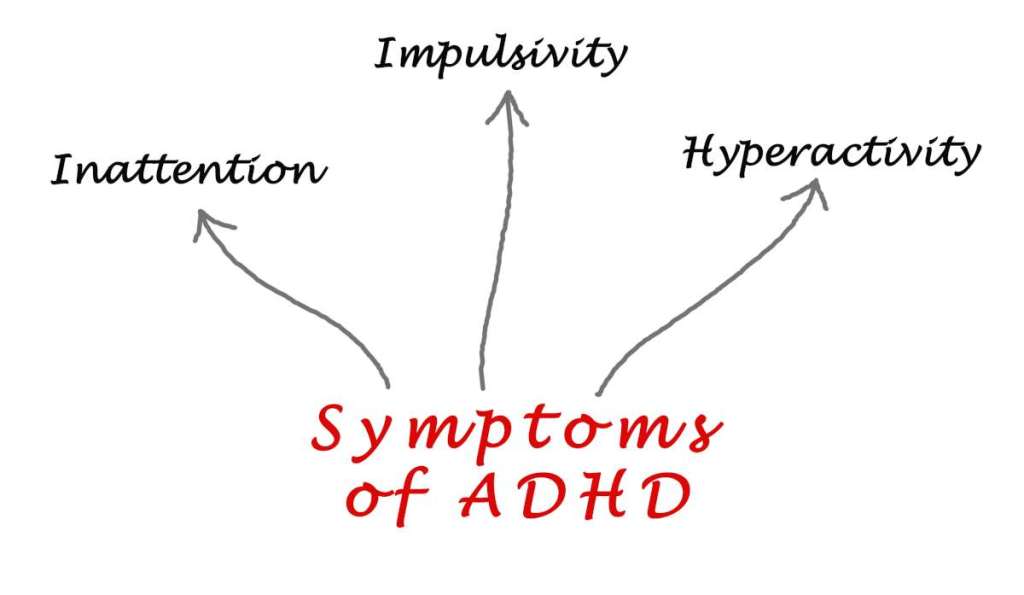
Three are the core symptoms of ADHD:
- Attention Deficit
- Hyperactivity
- Impulsivity
Clinically there are 3 types in each of which inattention, hyperactivity / impulsivity or both (combined type) predominates. The disorder is chronic so it goes without saying that the symptoms should last for at least 6 months. The importance of the above lies in the fact that at times everyone can experience some of the symptoms of the disorder e.g. in times of intense stress or fatigue. In addition adult adhd symptoms should have started in childhood or adolescence regardless of whether they were recognized then or not.
It is also important that the symptoms should cause a noticeable disturbance in the functioning of the child or adult.
Attention Deficit Disorder
Attention is a higher mental function through which active or passive focus on sensory data or other higher functions is achieved.
In ADHD, a core symptom is Attention Deficit, the existence of which results to the difficulty on various occupations and obligations of everyday life. Attention is easily distracted by external (or internal such as thoughts) stimuli.
Symptoms of distraction
They may be expressed by a dysfunction in one or more of the following properties of the attentional function:
- Maintenance of attention
- Attention shift from one stimulus to another
- Prioritization of focused attention, that is, to select what is important to pay attention each time
- Inhibition of attention to non-priority stimuli
- Working memory, i.e. the immediate and short-term retention of information in memory
The above eventually translates into difficulty concentrating, in some people little and in others more.
🔸The manifestations of dissociation include distraction, which is observed to a greater degree and frequency in people with ADHD. Typically, the person often experiences involuntary disconnections from immediate reality, with a tendency to daydream or get lost in thoughts. A particular feature is that he or she often seems not to listen to what is being said in a conversation and needs repetition.
🔸The person suffers from a lack of order and organization, loses things, forgets things, has difficulty completing tasks that require repetitive mental effort such as a university or work assignment, and misses details.
🔸Often there is difficulty in multitasking, i.e. dealing with more than one thing at a time.
🔸In some cases a trick is learned early on : focusing attention through the presence of a secondary stimulus that acts as a kind of anchor or booster. Example reading only when music is playing in the background. According to some the explanation is that a subpopulation of people with ADHD start from a lower level of quantitative alertness and the second stimulus helps to reinforce it to achieve attentional activation.
Hyperactivity
Περιγραφή…Hyperactivity manifests itself in constant aimless movements, e.g. of the feet (fidgeting) or pacing back and forth, difficulty staying in one place (tendency to move constantly), subjective feelings of impatience and tension, talking excessively, easily switching topics, and interrupting others when they are speaking.
🔸When there is no immediate stimulus for focus, this innate lack of calm prevails, sometimes causing “interference” in brain function and confusion. This results in an inability to tolerate situations of inactivity or, in other words, an above-average aversion to boredom.
“I always feel like I have to do something, but I don’t know what.”
🔸For many, hyperactivity manifests itself in thoughts, i.e., as a problem where many different thoughts accumulate without sufficient organization and hierarchy in the mind, creating confusion and dysfunction.
🔸Sometimes there are problems with motor coordination, resulting in clumsy behavior (which can contribute to low self-esteem).
On the other hand, it should be noted that areas of relative strength for many with ADHD include hands-on, constructional, mechanical, artistic, and athletic pursuits—often shaping academic or career paths.
Impulsivity
Impulsivity manifests itself in thoughtless actions and impatience, and can have unpleasant consequences in everyday life, such as frequent arguments, problematic driving with many tickets or accidents, delinquent behavior, excessive spending, frequent changes in partners, and inability to stabilize at work and in relationships. Finally, another important issue is substance addiction, most commonly alcohol, a condition that complicates and hinders the therapeutic approach.
Learn more in the special article on impulsivity.
Additional clinical features
Emotion regulation
Emotion regulation is defined as an individual’s ability to modify an emotional state in order to promote adaptive goal-directed behaviors. It has long been recognized that dysregulated emotional functioning is common in individuals with neurodevelopmental disorders, including ADHD, at a rate of up to 70%. Related manifestations may include intense emotional volatility, aggression, irritability, and outbursts of anger.
Motivation
Adult ADHD is a condition in which motivation may be lacking. In terms of lack of motivation, there is an apparent similarity to depression. It is a common feature of people with ADHD that although they want to do things, they are unable to get started. Motivation does not come with low-intensity stimuli, but usually with escalating anxiety or due to learning behaviors that subjectively provide more immediate rewards.
Indecisiveness often occurs even on minor issues.
Procrastination
People with ADHD are much more likely to procrastinate than the general population. Procrastination has multiple causes and may be due to reduced interest, increased impulsivity, temporal disconnection, preference for immediate reward, or deficits in prospective memory.
Learn more in the special article on procrastination in ADHD and its causes.
Reward processing
As children mature (often after the age of 18), they develop a trait called delayed gratification. In short, this means the ability to make an effort and act without expecting immediate but rather long-term rewards. Related research shows that individuals with ADHD have varying degrees of deficit in the development of this ability.
Ultimately, anything that does not bring immediate satisfaction/pleasure is not a sufficient stimulus to activate attention. Focusing attention on more neutral/indifferent/negative stimuli is particularly difficult for people with ADHD, regardless of whether these stimuli may be of great importance in the long term.
In fact, all people will focus more on what they like. That is, this does not happen exclusively in individuals with ADHD, but to a much greater extent in them. Essentially, this has to do with the brain’s immediate reward system. Since we receive immediate reward (pleasure) by doing what we like, we choose to do it more often and devote ourselves to it.

Hyperfocus
ΠεριγραφήOne thing that needs to be clarified is the fact that many children or adults with ADHD symptoms can concentrate, and indeed to a high degree, on things they enjoy. Related to this is the phenomenon of “hyperfocus,” or “overconcentration” on something. It is considered to be a kind of counterbalancing mechanism to attention deficit.
This often creates confusion in the world’s perception of the disorder in various ways. Either that if there is a possibility of concentration, there is no ADHD, or that the person is well-behaved or lacks the will to try and focuses exclusively on what they want.
In general, ADHD is not considered a problem of willpower but a dysfunction in execution and the reward system.
How is ADHD diagnosed?
Diagnosis is established through a clinical assessment by a psychiatrist; specialized written questionnaires can support evaluation. No biological markers or other diagnostic laboratory tests currently exist for ADHD.
- Symptoms present in two or more settings (home, school/work, peers/relatives).
- Onset in childhood/adolescence.
- Clinically significant impairment in academic, occupational, or social functioning.
- Consider severity spectrum—from mild to severe; not “all-or-nothing.”
Certification of diagnosis for adults can be provided by a private psychiatrist. It carries the same validity as a public-sector diagnosis for academic settings (subject to each institution’s policy). The impact on educational accommodations depends on the institution.
Disorders that may co-occur
No feature of ADHD is so unique that it cannot be found to some degree in most people without ADHD.
For example, under high stress, one’s ability to concentrate may be reduced.
Problems with attention, concentration, and hyperactivity can be seen occasionally or more frequently in people with other diagnosed conditions.
ADHD shares features with other disorders such as bipolar disorder and borderline personality disorder.
The specialist psychiatrist will consider whether:
- symptoms are due to ADHD, or
- represent another disorder, or
- reflect comorbidity.
These are also reasons that fuel skepticism about the diagnosis. Important discussion with implications for the future concerns:
- whether ADHD should be viewed as a disorder,
- whether it may reflect a personality type,
- and the degree to which cultural factors (e.g., workplace culture) pathologize difference, while positive aspects are underestimated.
In adults, the clinical picture may not be obvious and can be missed due to high rates of comorbidity with anxiety disorders, mood disorders, and substance abuse. In essence, comorbid presentations are more common than “pure” inattention alone. For example, ADHD and anxiety are closely intertwined.
Note: in “pure” ADHD there is no intellectual disability.
People with ADHD can also be on the autism spectrum (e.g., high-functioning autism, formerly Asperger).
Symptoms of inattention and hyperactivity also appear secondarily within subtypes of autism spectrum disorder (ASD) and other neurodevelopmental disorders.

To be clear: without diagnosis and treatment, ADHD can affect productivity, have significant life consequences, and contribute to other disorders such as depression and dependencies that may further worsen outcomes.
The non-neurotypical brain
Selected research findings identify differences in brain function in ADHD:
- A large longitudinal study found that for most cortical regions, children with ADHD reach peak cortical thickness several years later than typically developing peers, supporting a developmental delay.
- The default mode network (DMN) appears overactive. This network (inferior parietal cortex, medial prefrontal cortex, posterior cingulate) is active at rest or during routine processes without active external focus. It may not deactivate sufficiently during tasks or may intrude on task processing (Cortese et al., 2012). Inconsistency may arise from faulty interaction between the DMN and task-positive circuits.
- Underactivation of fronto-parietal networks (lateral frontal pole, dorsal anterior cingulate, dorsolateral prefrontal cortex, lateral cerebellum, anterior insula, inferior parietal lobule) is observed in children, but especially in adult ADHD—linked to executive dysfunction, prioritization, decision-making, and time perception.
- The dorsal attention network supports selection based on internal goals; the ventral attention network supports re-orienting to salient external stimuli. The ventral network may be underactive—or sometimes overreactive—contributing to distractibility.
- Prospective memory deficits (remembering to perform intended actions) can occur.
- Underactivation of the sensorimotor network is seen in a subset of children (hyperactive type); compensatory upregulation of visual circuits may occur.
We should note that the above are indicative, and—as always—more research across domains is needed to deepen understanding. Open questions include:
- Whether dysfunction is primarily top-down (faulty cortical control) or bottom-up (faulty response/feedback from subcortical affective structures)—or both.
- Differences between adult and childhood ADHD, including why certain symptoms remit in adulthood (possibly with prefrontal maturation) while others (e.g., executive dysfunction) may worsen for some adults.
- The intriguing possibility that some pathological changes are not purely neurodevelopmental but also shaped by the longitudinal course via person–environment interactions.
Myths about ADHD
ADHD symptoms and causes are often misunderstood. Some even wrongly dispute ADHD as a diagnosis. The volume and validity of scientific literature leave little room for doubt.
In general, the brain of people with ADHD shows neurobiological differences. Common myths include:
- It is not the result of inadequate/poor parenting (though parenting and environments can influence outcomes).
- It is not laziness or stigma-related weakness.
- Inattention in ADHD is not intentional behavior.
- Not a deficit of understanding or intelligence—though it may appear so to the unacquainted observer.
- ADHD symptoms do not fluctuate randomly but are relatively consistent.
- Symptom severity ranges from mild to severe.
- With development—especially in adulthood—hyperactivity may decrease.
- Functioning can be normal for some. Moreover, many with ADHD are highly talented and successful.
- You cannot force someone with ADHD to concentrate—no more than you can force someone to lift beyond their muscular capacity. Some adopt compensatory mechanisms over time.
- ADHD is not caused by excessive sugar, soda, video games, social media, or TV—though these can exacerbate symptoms.
ADHD management & treatment
ADHD should be treated when it causes noticeable distress and functional impairment.
Optimal outcomes typically combine the following pillars:
- Medication — the principal therapeutic approach
- Treatment of comorbidities
- Psychotherapeutic interventions:
- Cognitive Behavioral Therapy (CBT)
- Psychoeducation
- Counseling (Structured interventions for time management/goal setting)
- Exercise — often important for symptom management
- Sleep hygiene — supports attention and functioning
Medication for ADHD
Pharmacologic treatment yields very good results in most cases. Medications primarily target inattention and concentration.
They can also have beneficial effects on associated symptoms such as mental hyperactivity, emotional dysregulation, and executive functioning.
🔸 Methylphenidate—a CNS stimulant—acts by inhibiting dopamine and norepinephrine reuptake, increasing their synaptic concentrations. In Greece it is available as:
- immediate-release, shorter-acting (Ritalin)
- extended-release, longer-acting (Concerta)
Given the significant dopaminergic and noradrenergic innervation of the prefrontal cortex—a region critical for attention, motor activity, and impulsivity, as well as decision-making and problem-solving—this action of methylphenidate is therapeutic.
🔸 With a similar rationale, but acting only on noradrenergic transmission, atomoxetine (Strattera) has an official indication for ADHD (its availability in Greece has been intermittent).
🔸 Other second-line options include modafinil (modiodal/aspendos) and activating antidepressants such as bupropion (Wellbutrin) and venlafaxine (Effexor).
Medication should be prescribed under the supervision of a psychiatrist, primarily for titration. There is a small but real risk of dependence with methylphenidate (with misuse). Monitor for adverse effects and interactions. Treat comorbidities according to the predominant clinical picture.
For example, in cases of alcohol misuse, detoxification should be undertaken first, followed by attention-targeted treatment.
Read more about CNS stimulants used in ADHD treatment.
Exercise & ADHD
The benefits of regular physical exercise are well known across many (mental and non-mental) disorders. Studies indicate that exercise positively affects attention through endorphin release and indirect enhancement of dopamine and norepinephrine levels. Exercise also reduces tension and the drive for hyperactivity. It is recommended as an adjunctive approach to reducing ADHD symptoms, and in a minority it can suffice as a primary intervention.
The online ADHD community http://www.adhdforum.gr is a particularly useful Greek-language site. The forum discusses specialized topics (e.g., COVID-19 challenges for adults with ADHD) and hosts self-help groups.
Reddit community also includes interesting topics for discussion on ADHD
Book
Highly recommended: “Scattered Minds” by Gabor Maté—an excellent, multidimensional exploration of ADHD.
Videos
👉 A TV presentation about ADHD—characteristics, recognition, continuity from childhood to adulthood, when treatment is needed, and strengths of people with ADHD.
👉 A public awareness video about ADHD
The recognition of ADHD in adults, adolescents, or children should serve to foster understanding and support, not a judgment that something is irreparably wrong or a label that defines an entire person.
References
- American Psychiatric Association. Diagnostic and Statistical Manual of Mental Disorders (5th ed.; DSM-5, DSM-5-TR).
- World Health Organization. International Classification of Diseases (11th Revision; ICD-11), ADHD.
- Cortese S. et al. Default mode network in ADHD (2012).
- Peer-reviewed sources on cortical maturation, executive networks, and reward processing in ADHD.