
NON-INVASIVE NEUROMODULATION
rTMS (repetitive Transcranial Magnetic Stimulation) is a non-invasive neuromodulation therapy that uses repetitive magnetic pulses to modify the activity of specific brain networks. The strongest clinical evidence concerns major depressive disorder, particularly when previous treatments have not provided adequate response.
No anesthesia
Outpatient therapy
Immediate return to daily life
≈3′ with iTBS
or 20′ with conventional protocols
Strongest evidence
in depression
What is rTMS?
rTMS stands for repetitive transcranial magnetic stimulation. It is a non-invasive neuromodulation technique: a specialized coil is placed externally on the head and produces brief magnetic pulses, which induce an electrical field in the cerebral cortex.
It is not electroconvulsive therapy (ECT), does not require general anesthesia, and usually does not cause cognitive impairment. The patient remains awake during the session and can return to normal activities immediately afterward.
Important clarification: “TMS” is not a single protocol. The frequency, intensity, number of pulses, target region, and coil type can vary depending on the diagnosis and therapeutic protocol.
How does rTMS work in the brain?
The fundamental physical principle is electromagnetic induction: the coil creates a rapidly changing magnetic field, which induces an electrical field in the cerebral cortex. The induced electrical field can activate neural elements in the target region without requiring surgery or current transmission through the skull.
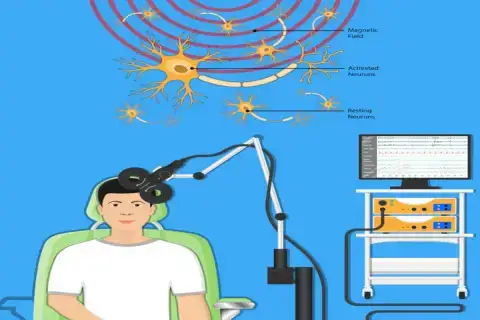
The induced electrical field modifies cortical excitability. The direction and magnitude of this effect depend on stimulation parameters — such as frequency or pattern of pulses, intensity, and number. A single stimulation has brief effects, whereas repeated therapeutic protocols can produce changes lasting longer than the session itself.
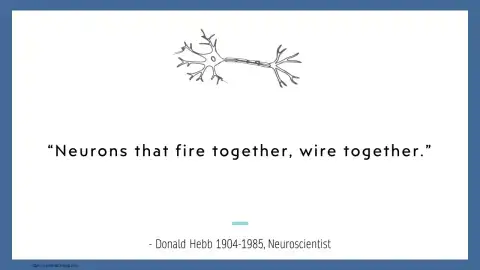
Repeated stimulation can affect synaptic plasticity mechanisms and create changes in neural circuit function that persist after the session ends. Donald Hebb’s principle that “repeated co-activation of neurons can strengthen their connections” is a useful theoretical model for understanding neuroplasticity, without by itself describing the entire mechanism of rTMS action.
The effects of rTMS are not limited to the site directly beneath the coil. Through the brain’s anatomical and functional connections, broader networks involved in mood regulation, anxiety, cognitive function, reward processing, or pain perception can be affected.
Neuroimaging and neurobiology studies have also documented changes in functional connectivity, blood flow, neurotransmitter systems, and neurotrophic mechanisms.
Stimulation is directed at specific cortical regions and the networks to which they connect, without systematic exposure of the body characteristic of pharmacotherapy. In depression, for example, a common therapeutic target is the dorsolateral prefrontal cortex (DLPFC). Targeting is localized to the point of application, but the therapeutic effect can address a broader brain network.
In which disorders is rTMS used today?
The scientific evidence for rTMS is not identical across all conditions. In some disorders it has become an established therapeutic option with strong data, while in others the indications are encouraging but protocols continue to evolve. Select a category for more information.
rTMS and Depression
Major depressive disorder is today the best-documented psychiatric application of rTMS. Large randomized trials, meta-analyses, and current guidelines support its efficacy, particularly when previous treatments have not provided adequate response.
rTMS has a special role in treatment-resistant depression, when one or more adequate therapeutic trials with antidepressants have not produced the desired result. It can also be an important option when pharmacotherapy causes side effects or is poorly tolerated.
Treatment can be administered in parallel with antidepressant medication or, in selected cases, without it.
In the US, FDA clearances have been granted for specific TMS systems and for treating depression in adolescents and young adults. Regulatory approvals apply to specific devices, age groups, and protocols, not to every form of TMS.
Obsessive-Compulsive Disorder (OCD)
Obsessive-compulsive disorder is another important psychiatric application of TMS. Specific protocols have been designed to affect the cortico-striatal and prefrontal circuits involved in OCD pathophysiology.
In the US, specific TMS systems and protocols have received FDA clearance for OCD. Similarly, in Europe, systems with specific intended uses are available according to European medical device legislation.
This distinction matters: evidence and regulatory approval apply to specific protocols and systems, not meaning that every form of rTMS or every stimulation region is equivalent for OCD.
Chronic and Neuropathic Pain
rTMS has been extensively studied in chronic and neuropathic pain syndromes. Specifically, high-frequency rTMS of the primary motor cortex (M1), contralateral to the painful region, has received high levels of evidence in European evidence-based guidelines for specific forms of neuropathic pain.
Response is not identical across all pain syndromes and depends on etiology, target region, and the protocol used.
Fibromyalgia
In fibromyalgia, randomized trials and meta-analyses have reported pain improvement and, in some studies, improvement in quality of life and associated mood symptoms. However, there remains significant heterogeneity regarding the brain target, protocol, and duration of effect.
Peripheral Magnetic Nerve Stimulation – mPNS
A separate but related field is Magnetic Peripheral Nerve Stimulation (mPNS), where magnetic stimulation is applied to peripheral nerves rather than the brain. Early clinical trials have shown encouraging results in some forms of chronic neuropathic and musculoskeletal pain, but the literature is still significantly smaller than that of rTMS.
rTMS and Addictions
TMS is an emerging field of complementary therapeutic intervention in substance use disorders. Research particularly focuses on modulating the prefrontal and mesolimbic networks involved in reward, impulse control, and drug craving.
Most clinical data to date concern nicotine, cocaine, and alcohol. Studies have also been published on other behaviors related to craving and reward, including binge eating, but the strength of evidence varies significantly among indications.
In Europe there are specific TMS systems with CE marking for certain applications in substance use disorders. However, this does not mean that every addiction has the same level of clinical evidence, or that there is a common protocol for all substances.
rTMS and Smoking Cessation
Nicotine dependence is the most mature application of TMS in the field of addictions. Specific deep TMS systems have received FDA clearance in the US for short-term smoking cessation.
Clinical trials have shown that repeated stimulation of prefrontal regions can reduce craving, dependence, and cigarette consumption in some patients. This application does not necessarily replace other evidence-based smoking cessation interventions, but can serve as an additional therapeutic option.
Generalized Anxiety Disorder (GAD)
For generalized anxiety disorder, there are positive randomized trials and meta-analyses suggesting that rTMS can reduce anxiety symptoms.
However, the relevant literature is smaller than that for depression, and there is significant variation among studies regarding the side and region of stimulation, frequency, and number of sessions. For this reason, GAD remains more of an emerging rather than fully standardized indication.
Post-Traumatic Stress Disorder (PTSD)
In post-traumatic stress disorder, different rTMS protocols have also been studied, mainly in prefrontal regions, with several studies showing symptom improvement.
The results are encouraging, but the heterogeneity of protocols and populations does not yet permit the same standardization that exists for depression.
rTMS and Schizophrenia
In schizophrenia, rTMS has been studied mainly for two symptom groups: persistent auditory hallucinations and negative symptoms.
For auditory hallucinations, inhibitory low-frequency protocols have been used mainly in temporoparietal regions, while for negative symptoms, excitatory protocols in prefrontal regions have been more frequently investigated.
Evidence-based European guidelines recognize positive data for some of these applications, but study results are not uniformly consistent. rTMS therefore does not replace the basic treatment of schizophrenia, but is a possible complementary intervention for selected persistent symptoms.
Other Applications of TMS
Non-invasive magnetic neuromodulation is a particularly active research field and is being examined in many other neurological and neuropsychiatric conditions.
- Alzheimer’s disease and other dementias
- Parkinson’s disease
- Recovery after stroke
- Migraine and other headaches
- Tinnitus
- Eating disorders and pathological craving
- Other neuropsychiatric conditions under clinical investigation
In these applications, it is essential to clearly distinguish between positive research findings, evidence-based therapeutic recommendation, and formal regulatory indication. The fact that published studies exist for a condition does not automatically mean that rTMS is an established therapy for it.
Overall: the efficacy of rTMS depends on diagnosis, target region, form and frequency of stimulation, and the specific therapeutic protocol. For this reason, it is incorrect to treat “rTMS” as a single therapy applied in the same way for all conditions.
rTMS Approvals in the US and Europe
TMS has been in clinical use for many decades and the officially recognized therapeutic applications have gradually expanded. Click to view some of the most important milestones in the US and Europe.
What are TBS and iTBS?
Theta Burst Stimulation (TBS) is a special way of delivering TMS, where magnetic pulses are organized into brief “bursts” of high frequency. The most well-known therapeutic form in depression is intermittent Theta Burst Stimulation (iTBS).
Conventional rTMS
Depending on the protocol, a typical session can last approximately 20 minutes or more.
iTBS
In established protocols for depression, the stimulation itself is completed in approximately 3 minutes.
The large clinical trial THREE-D and subsequent meta-analyses showed that iTBS can have comparable efficacy and safety to conventional high-frequency rTMS in depression, with the significant practical advantage of much shorter session duration. There are 2 types of TBS, iTBS & cTBS.
How effective is rTMS?
There is no single success rate applicable to everyone. The likelihood of response is affected by diagnosis, disease severity and chronicity, number of previous failed treatments, protocol, number of sessions, and other clinical factors.
In depression, meta-analyses consistently show that active rTMS outperforms sham with respect to symptom reduction, clinical response, and remission. In patients with treatment-resistant depression, the benefit remains clinically significant even after multiple previous treatment failures.
Realistic expectation: rTMS is not a therapy with guaranteed results. Proper patient selection, appropriate protocol, adequate duration, and systematic monitoring of response are critical.
For whom might it be suitable?
In everyday clinical practice, rTMS is considered when:
- depression or another suitable indication has not responded adequately to previous treatment,
- medication side effects are significant or limit options,
- there is desire for a non-invasive therapeutic option without anesthesia,
- it is considered appropriate as complementary therapy along with pharmacotherapy or psychotherapy.
Indication is not based on diagnosis alone. Comprehensive assessment of history, previous treatments, medications, neurological history, and potential contraindications is needed.
Is rTMS safe? Safety and Tolerability
rTMS is generally considered a well-tolerated, non-invasive therapy with a favorable safety profile when applied according to established protocols and after appropriate eligibility screening. The possible most common side effects are usually mild and temporary.
Common, Mild, and Temporary Side Effects
- headache,
- scalp discomfort or tenderness,
- transient muscle contractions during stimulation
Precautions
Before starting, special screening is performed for metal or electronic implants near the head, history of seizures, and other factors that may affect safety or protocol selection.
- An epileptic seizure is an extremely rare complication when established safety limits are observed.
- In vulnerable individuals, rare (hypo)manic activation has been reported. This is monitored through observation during treatment.
- Hearing protection is typically used during treatment for the characteristic sound of the pulses.
An important feature of rTMS is that, unlike systemic pharmacological therapies, it does not present many of the side effects associated with drug action throughout the body:
- Weight gain and metabolic disorders are not characteristic side effects of rTMS.
- Sexual dysfunction is not a characteristic side effect of rTMS.
- It does not cause pharmacological-type sedation and does not require washout time after the session.
- Available data do not show generalized negative effects on memory, concentration, or other cognitive functions.
How is rTMS treatment performed?
- Clinical evaluation. Detailed history is obtained, diagnosis is confirmed, and previous treatments, medications, comorbidities, and potential risk factors are assessed.
- Safety screening and informed consent. Screening is performed for metal or electronic implants near the head, neurological history, and other factors that may affect safety or protocol choice.
- Motor threshold and targeting. At the first session, measurements are taken so that stimulation intensity can be individualized. The coil is positioned in the appropriate region based on the protocol.
- Therapeutic sessions. The patient sits in a specialized chair, remains awake, and hears the characteristic sound of the pulses. Hearing protection is used.
- Response monitoring. Symptoms are systematically assessed during the course of treatment and the protocol is re-evaluated when needed.
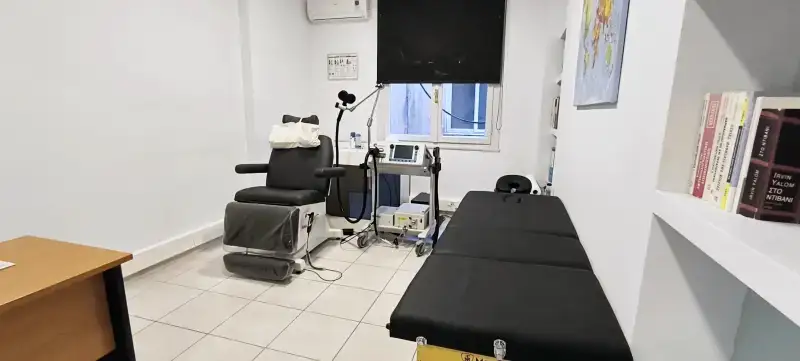
The entire process is straightforward, requires no hospitalization, recovery time, anesthesia, blood tests, or other investigations, and the patient returns normally to daily activities after the rTMS session. Treatment is conducted in the dedicated facility of Smart CNS Center in central Athens. Protocol selection and response monitoring are made following individualized clinical evaluation.
How many sessions are needed and how long do they last?
The exact number depends on the indication, protocol, and response. In depression, an acute therapeutic course typically includes multiple sessions on a daily basis, five days a week, for several weeks.
In clinical practice, approximately 20–36 sessions are often required, though in some patients treatment may be extended when response appears later. Conventional protocols may last approximately 20 minutes or more, while a typical iTBS depression protocol completes stimulation in approximately 3 minutes.
Are maintenance sessions needed?
After successful acute treatment, some patients use continuation or maintenance sessions. The need and frequency are not identical for everyone and are individualized based on relapse risk, history, and duration of initial response.
Cost of rTMS
Total cost depends mainly on the number of sessions and therapeutic plan.
An appropriate plan is determined after initial evaluation, so it is clear from the start which protocol is recommended and how many sessions are expected.
Frequently Asked Questions About rTMS Therapy (FAQ)
Scientific sources and guidelines
- Trapp NT et al. Consensus review and considerations on TMS to treat depression. Clinical Neurophysiology, 2025.
- Lefaucheur JP et al. Evidence-based guidelines on the therapeutic use of repetitive transcranial magnetic stimulation. Clinical Neurophysiology, 2020.
- Rossi S et al. Safety and recommendations for TMS use in healthy subjects and patient populations. Clinical Neurophysiology, 2021.
- Blumberger DM et al. THREE-D: iTBS versus high-frequency rTMS for depression. The Lancet, 2018.
- Vida RG et al. rTMS adjunctive therapy after two antidepressant treatment failures: meta-analysis. BMC Psychiatry, 2023.
- NICE. Repetitive transcranial magnetic stimulation for depression.